

Who regulates the media?
In the UK, broadcast media channels are regulated by Ofcom – the Office of Communications.. At the heart of this is the Ofcom Broadcast Code. For the purposes of journalism, the sections you’re likely to be most interested in are Due Impartiality and Due Accuracy (Section 5), and the regulations around Elections and Referendums (Section 6), though all parts of the Code apply to any broadcast output – be in news bulletins, current affairs strands or straightforward music shows on the radio.
Case Studies involving Ofcom
As a regulator, Ofcom is appointed by the UK Government to carry out scrutiny across a range of communications functions. This includes telephone, wifi and broadcast services. Ofcom has a range of statutory powers, meaning it can sanction or fine a company if it fails to provide any service or is in breach of its regulations. Some critics question whether Ofcom is doing its job effectively, or whether it is selectively ignoring some big issues while amplifying relatively minor matters. The following case studies illustrate contrasting approaches to regulation.
Ofcom vs GB News
GB News is a free to air TV channel in the UK. Launched in June 2021, it set out on a mission to become one of the first opinion-led broadcasters in the country, championing free speech, and claiming that “nobody will be cancelled”. It branded itself as “The People’s Channel,” led by the views of its audience. Ever since the launch, critics have been quick to point out that GB News – in general terms – has a roster of mainly right wing presenters and guests, though the channel disputes this.
More controversially, GB News employs a number of serving politicians to present programmes. This has led to an uneasy relationship with the regulator, and Ofcom has found the channel in breach of the Broadcast Code several times. Below is a timeline of events to date, which will be updated an new events happen.
Ofcom and local news in commercial radio
In recent years, commercial radio has become a consolidated business of large network stations, built by big companies buying up stations that previously had lots of local output for their own area. Salisbury’s Spire FM is just one of dozens of stations bought by Bauer Media, and in 2020 it bacame part of Greatest Hits Radio. (GHR).
In return for running mainly networked programmes (including an Afternoon show across the South of England), GHR was required to produce “enhanced local news” for the Salisbury area. Importantly, this was distinctive from the wider country of Wiltshire and neighbouring Hampshire, which came under different licensing areas.
In early 2024, GHR decided to drop its bespoke local news for Salisbury, opting for news covering the wider region. Ofcom investigated a complaint that GHR Salisbury was no longer meeting its requirement for local news. GHR claimed that its local news in Salisbury sounded “too parochial”. However, the station ended what it called “an experiment” and reverted to local news,
The case highlight’s Ofcom’s Localness Guidelines and how they relate particularly to local news provision. While the regulator carries out a limited amount of monitoring, investigations like these are only triggered if there has been a complaint. In this case, only one complaint was made. Because of confidentiality, we don’t know who complained or why. However, it has been known within the industry for rival broadcasters to file complaints, because they too are subject to the same regulations.
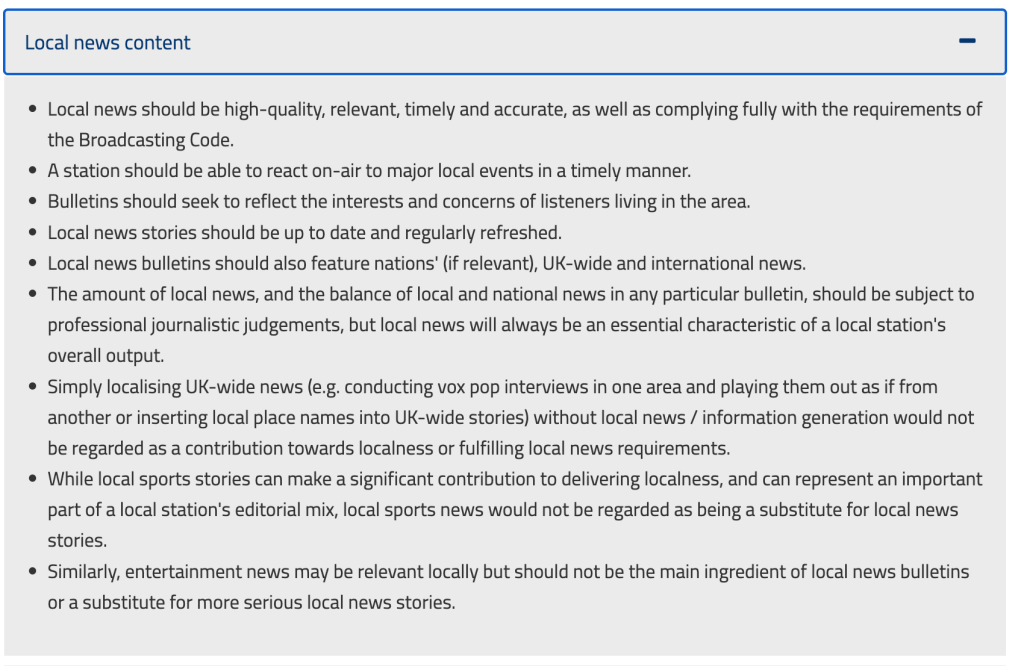
Taken from Ofcom’s Localness Guidelines, here’s an idea of what the regulator deems to be “local”
 kevinstanley.blog